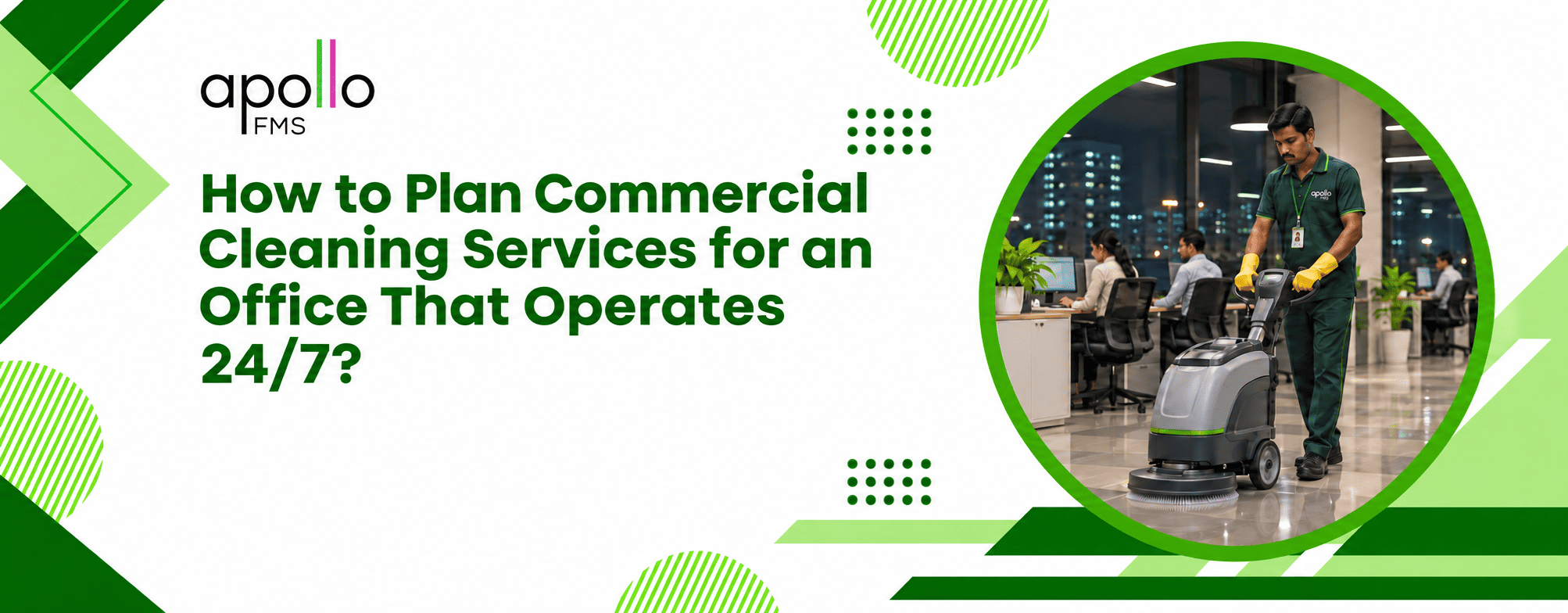
A 24/7 office never has an empty-building window. Cleaning must fit around live work. A clear plan for commercial space cleaning keeps the space hygienic without slowing anyone down.
Plan commercial cleaning services around occupancy. Divide the office into zones. Assign clear cleaning duties to each shift. Run short cleaning rounds while people work. Save noisy or disruptive tasks for quieter periods. Review the plan whenever headcount or shift patterns change.
Why Standard 9-to-6 Cleaning Plans Fail in 24/7 Offices
Conventional office cleaning assumes a long overnight gap when crews can run scrubbers, block corridors and leave floors to dry. In a 24/7 facility, applying a single-shift mindset creates three immediate operational failures:
- Shift-Change Bottlenecks: In a typical three-shift office (for example, 06:00, 14:00 and 22:00 changeovers), cab drop-offs and cafeteria rushes collide with floor mopping and bin clearance in lobbies, lifts, and pantries.
- Acoustic & Air-Quality Disruption: High-decibel vacuuming near active voice/support bays or strong chemical fumes in sealed, air-conditioned zones disrupt night-shift teams and trigger indoor air quality (IAQ) complaints.
- No cover for night-shift absences: A single absent attendant on the graveyard shift leaves washrooms and pantries unserviced before the morning wave arrives.
What Should You Assess Before Creating the Cleaning Plan?
Start with how people actually use the space. Walk the floor at different times of day.
-
Map occupancy for each shift.
Map exact headcount across Shift A (06:00–14:00), Shift B (14:00–22:00), and Shift C (22:00–06:00). Note the 30-minute arrival and departure surges at main turnstiles, security desks, and passenger lifts.
-
Note busy entrances, shared workstations, washrooms, and pantries.
In overnight support offices, floor occupancy often falls after midnight, while pantry and washroom use stays steady.
-
List access restrictions and quiet zones.
Flag NOC rooms, voice-process bays, boardrooms, and executive cabins that require silent cleaning methods during active calls.
-
Flag tasks that need approval from office or IT teams.
Identify server rooms, UPS rooms, HVAC AHU rooms, DG sets, and electrical panel rooms. Dust removal in these high-risk technical spaces requires joint permit-to-work (PTW) sign-off from IT and engineering maintenance teams.
The night shift is smaller, but pantry and washroom use stays steady. Meeting rooms sit empty after midnight. That pattern calls for a different plan than the day shift needs.
How Do You Set Cleaning Priorities for Each Zone?
Not every area needs the same attention.
Set frequency by footfall, observed conditions, and the agreed service scope. Cover desks, meeting rooms, washrooms, pantry areas, and waste collection. Do not copy one schedule across every office. Each site differs.
High-touch points, such as door handles, switches, and shared equipment, usually need the most frequent attention. Sort tasks into three levels:
1. Tier 1: Continuous Touch-Up & Sanitation Zones (Every 60–90 Minutes)
- Areas Covered: Washrooms, pantries, cafeteria counters, biometric turnstiles, lift buttons, and main glass doors.
- Execution Protocol: Janitors use red (urinals/WC fixtures) and yellow (washbasins, mirrors, tiles) colour-coded tools in washrooms, and green food-safe microfiber in pantries. Consumables (handwash, paper towels, toilet rolls, sanitiser) are checked and replenished before every shift change. Follow the colour-coding standard in your site’s SOP.
2. Tier 2: Section-Wise Routine Cleaning (Shift-Transition Windows)
- Areas Covered: Open workstation bays, huddle rooms, internal glass partitions, corridors, and staircases.
- Execution Protocol: Use blue colour-coded dry microfiber dusters and low-noise backpack vacuums during the 45-minute buffer between shifts or scheduled team breaks.
3. Tier 3: Rotational Deep & Mechanised Cleaning (Low-Occupancy Windows)
- Areas Covered: Carpet shampooing, sofa upholstery extraction, high-reach cobweb removal, facade/external glass detailing, floor scrubbing/buffing, and technical room dry-dusting.
- Execution Protocol: Divide work into rolling weekly zones (e.g., Wing A on Saturday night, Wing B on Sunday night) using battery-operated single-disc scrubbers, wet-and-dry extractors, and high-pressure jet machines for external podiums, so no active workspace is ever cordoned off during peak hours.
How Should Cleaning Fit Around a 24/7 Shift Schedule?
Short, zoned cleaning rounds outperform long, disruptive sweeps. In a three-shift commercial facility, office cleaning services must work against the occupancy curve.
Below is an operational 24/7 schedule modeled on Apollo FMS’s multi-shift commercial deployments across India:
| Zone | Core Housekeeping Task | Optimal 24/7 Window | Frequency | Equipment & Staffing |
| Main Lobby, Turnstiles & Lifts | Glass wipe-down, mat vacuuming, dry/damp mopping | 10:30–12:00, 15:30–17:00, 01:00–03:00 (post-rush) | Every 3–4 hours | Lobby attendant; auto-scrubber (night window) |
| Workstation Bays (Occupied) | Dry microfiber wipe-down, individual bin clearance, chair alignment | 06:30–08:00, 14:30–16:00, 22:30–00:00 (shift transitions) | 3 times daily (1 per shift) | Shift housekeeper; blue microfiber & silent caddy |
| Meeting & Conference Rooms | Table sanitisation, whiteboard reset, crumb vacuuming, glass detailing | Immediate 10-minute reset between calendar bookings; full clean at 02:00 | On-demand + 1 nightly deep reset | Floor housekeeper linked to Apollo Tech Platform alerts |
| Washrooms (Male, Female, Accessible) | Fixture sanitisation, floor drying, odor control, soap/tissue restocking | Staggered 60-minute cycles (one bank closed at a time, alternate open) | 16–20 checks per 24 hours | Dedicated male/female washroom attendants |
| Pantry & Cafeteria | Counter degreasing, microwave/vending wipe-down, wet/dry waste segregation | 09:30, 14:30, 20:30, and 03:00 (immediately after meal/tea breaks) | 4–6 rounds daily | Pantry attendant; green food-safe tools |
| Corridors & Fire Staircases | Dust control mopping, skirting wipe-down, handrail sanitisation | 23:00–04:00 (low-footfall window) | Daily | Night-shift mechanised floor-care team |
| Server, UPS, HVAC & Panel Rooms | Antistatic dry dusting, cobweb removal, floor dry-wiping (zero water) | Scheduled weekend/off-peak window with IT/MEP escort | Weekly / Fortnightly | Trained housekeeper + Apollo MEP technician |
What Should Each Cleaning Shift Handover Include?
In a 24/7 building, service quality breaks down during the 15-minute gap between outgoing and incoming shifts if handovers rely on verbal updates or paper notebooks. Apollo FMS digitises shift handovers through its proprietary Apollo Tech Platform. It tracks over 50 facility management functions across web, mobile, and tablet devices, supported by on-site shift supervisors:
- Digital Job-Card Completion Log: Timestamped sign-off of completed zones and flagged pending bays (for example, a conference room where an executive meeting overran past 22:00).
- Open Ticket & Spill Escalations: Active helpdesk tickets with target TAT countdowns (such as a pantry coffee spill or washroom plumbing leak referred to the MEP technician).
- Consumable & Chemical Stock Handover: Shift-end inventory counts for tissue rolls, handwash, garbage liners, and eco-friendly cleaning chemicals so the night shift never faces locked storerooms.
- Access Key & Permit Register: Log of restricted access cards, master keys, and active work permits for server or utility rooms.
- Buffer Manpower & Reliever Deployment: Verification of incoming shift attendance. As demonstrated in Apollo FMS’s deployments at Wonderla Chennai (281 personnel with 100% monthly manpower availability), maintaining trained buffer staff and cross-zone relievers prevents absenteeism from leaving any shift short-handed.
What to Agree With Your Provider?
An office cleaning company should document responsibilities in writing. Agree on response times for urgent requests. Confirm who approves changes to scope. Written terms prevent disputes later.
How Can Deep Cleaning Be Planned Without Disrupting Work?
Deep cleaning needs coordination. Talk to department leads first.
- Agree on desk access and timing.
- Schedule carpet care and noisy equipment for quiet windows.
- Allow drying time before reopening an area.
- Follow product instructions and site procedures.
- Use cleaning tools suited to each area.
- Get approval before working near sensitive equipment.
Rotate deep cleaning across zones. This way, no part of the office closes for long. Here’s what commercial cleaning services do to minimise disruption:
- Advance Floor-Map Notices (72 Hours Prior): Issue floor-wise schedules to department heads and IT floor marshals specifying which workstation pods or meeting wings will be serviced during Friday-night to Sunday-night low-occupancy windows.
- Low-Moisture Encapsulation for Carpets & Upholstery: Instead of soaking carpets (which takes 12–18 hours to dry and causes musty odors in sealed HVAC zones), use low-moisture encapsulation and high-suction extraction machines so bays reopen within 2 to 3 hours.
- Indoor Air Quality (IAQ) & HVAC Coordination: Coordinate deep cleaning with facility audit and IAQ checks and HVAC duct cleaning. Sealing and cleaning HVAC ducts alongside periodic floor deep cleaning removes airborne dust and allergens at the source.
- Lockout/Tagout Near Sensitive Assets: Get written IT/MEP clearance before cleaning near server racks, under-floor cabling, UPS batteries, or fire suppression panels.
How Do You Check Cleaning Quality and Improve the Plan?
A plan works only if you measure it. Use simple checks:
- Supervisor inspections
- Missed-task records
- Repeat complaints
- Consumable checks, such as soap and paper
Review the office housekeeping services schedule when occupancy changes. Review it again when the same problems keep returning. The office cleaning service provider and the office manager should agree on corrective actions. Set review dates and stick to them.
Good cleaning for office spaces is never fixed. It adapts as the workplace changes.
A successful commercial cleaning plan should always be monitored through live operational data:
- QR-Code & IoT Washroom Monitoring: Place QR-code scan checkpoints in every washroom and pantry for supervisor sign-offs, and pair high-traffic restrooms with IoT occupancy and odour sensors that trigger automatic attendant alerts after a set number of visits.
- Weekly Hygiene Scorecard Audits: Score every zone across 50+ checkpoints on the Apollo Tech Platform, tracking repeat defect patterns by shift and zone.
- Quarterly Scope Re-Balancing: Whenever a client adds a new night-shift project team or reconfigures floor seating, use ticket density and consumable burn-rate trends to reallocate janitorial headcount across shifts.
At Ramaniyam, a 3.2 lakh sq. ft. commercial property in Chennai, Apollo FMS replaced unsupervised housekeeping with trained staff, backup manpower and mechanised cleaning. hygiene audit scores rose above 95%, 90% of service requests closed within agreed TAT, and operations ran without service disruption.
Plan Office Cleaning Support with Apollo FMS
Every 24/7 office has its own rhythm. Managing round-the-clock office cleaning services requires structured shift governance, mechanised cleaning, 100% statutory compliance, and real-time digital tracking.
With over 30 years of operational experience, 4,000+ trained professionals, and 120M+ sq. ft. maintained across 300+ sites in 11 cities (including Bengaluru, Chennai, Hyderabad, Pune, Mumbai, Delhi NCR, and Jharkhand), Apollo Facility Management Services helps corporate infrastructure and admin teams run hygienic, audit-ready workspaces 24/7.
Explore our Soft Facility Management Services or contact the Apollo FMS team to schedule a site assessment and build a shift-aligned housekeeping plan for your facility.